
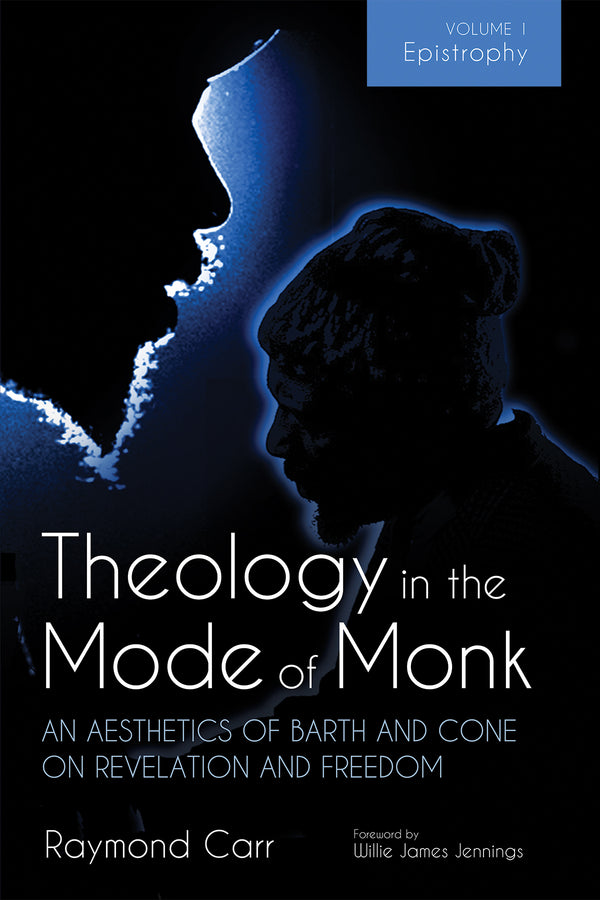
Theology in the Mode of Monk: An Aesthetics of Barth and Cone on Revelation and Freedom, Volume 1
Epistrophy: Historical and Hermeneutical Backgrounds
Also available as

Please note: eBooks must be read using the Glassboxx app. After purchasing, you will receive an email with instructions to access your eBook. Thank you for supporting us by buying direct.
About this book
Praise for this book
“Many of us who know the brilliance of Raymond Carr have waited for these volumes. They are epic. Here in volume one, Carr sets the stage for an astounding re-reading of Karl Barth and James Cone through the music of Thelonious Monk. The depth, subtlety, and artistic dexterity through which he articulates Barth and Cone’s theological projects is unmatched by any text I have ever read. This book is a turning point in Barth studies and emerging Cone studies.”
Willie Jennings, associate professor of systematic theology and Africana studies, Yale Divinity School
Dwight N. Hopkins, professor of theology, University of Chicago
“Thelonious Monk’s unprecedented aesthetics allow Raymond Carr to innovate brilliantly a mode that creates the interpenetration of James H. Cone and Karl Barth as supplementation and correction in counterpoint. In this groundbreaking first volume, Carr, himself a theological jazz creator and trickster theoretician, deploys history interpretation to set us up for the Monkian melodies in his forthcoming volumes two and three.”
Paul S. Chung, director, Karl Barth and Public Theology Center
“Raymond Carr undertakes an audacious attempt to construct ‘irregular theology’ in an aesthetic mode through which Karl Barth encounters James Cone. He interrogates and advances Barth’s thinking of freedom (Mozartean) down a line that includes James Cone’s spirituals and blues and Thelonious Monk’s jazz. In Carr’s groundbreaking proposal, Friedrich-Wilhelm Marquardt’s ‘logos of society’ finds significance in the Black experience of sociopolitical struggle. Do not miss this book!”
Davíd Carrasco, professor of the study of Latin America, Harvard Divinity School
“Raymond Carr is the Conjunto Cat! ‘Conjunto’ is Spanish for ‘to join together’ or a ‘set’ or a musical group. In Theology in the Mode of Monk, Carr has arranged a new polygonal bandstand on which appears a theological vision and practice whose main players are Karl Barth, James Cone, and Thelonious Monk! Watch out! Give a listen! Read deep! Conjunto can also mean totality, everybody! Come onstage by reading this book and join Raymond Carr’s conjunto.”
Cornel West, professor of philosophy and Christian practice, Union Theological Seminary
Raymond Carr is one of the few groundbreaking and path-blazing theologians of his generation! This magisterial trilogy on three of the towering spiritual giants of the past one hundred years gives us new terrain in our grim and dim times.”
Angela D. Sims, president, Colgate Rochester Crozer Divinity School
“Raymond Carr draws on a Black liberative tradition and employs Monk’s musical aesthetic for theological exploration. His trilogy, Theology in the Mode of Monk, invokes questions and invites readers to explore ideas and to challenge concepts of being.”
George Hunsinger, professor of systematic theology, Princeton Theological Seminary
“Raymond Carr has emerged as one of the most creative minds in contemporary African-American theology. His intensive engagement with James Cone and Karl Barth has already made a mark in the field but is now assured with the appearance of these remarkable volumes.”
Gary W. Burnett, senior fellow in New Testament, Belfast School of Theology
“With great erudition and care, Raymond Carr cleverly utilizes the jazz aesthetic of Thelonious Monk to help explore the theological relationships between Karl Barth and James Cone. As he does so, we see the importance of Christ’s faithfulness as our cantus firmus and hear an urgent call for the church to be prophetic as it hears the higher frequencies of God and the lower frequencies of the cries of the oppressed.”
Johanne Stubbe Teglbjærg Kristensen, associate professor of theology, University of Copenhagen
“Theology in the Mode of Monk is a masterpiece of theological aesthetics. Through Monk, Carr discloses obsolete philosophical systems before and after Karl Barth; and with James Cone signifyin(g) on Barth, he transforms deleterious theological, existential, and political systematics. Thus, this project attunes us to the sound(s) that arise from the cross of Christ—even as we improvise on that revolutionary melody and move to its rhythm(s).”
Have a manuscript? Submit a book proposal!
