
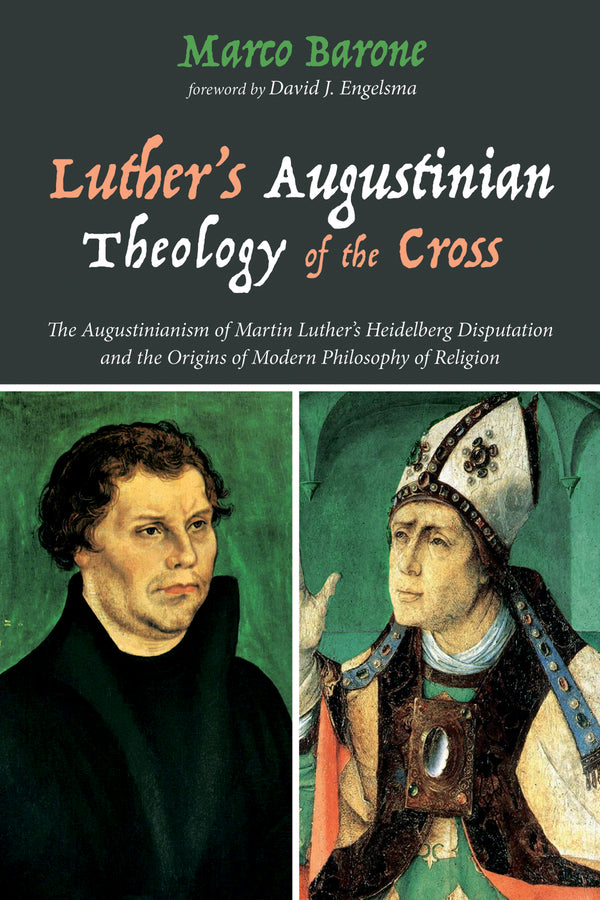
Luther’s Augustinian Theology of the Cross
The Augustinianism of Martin Luther’s Heidelberg Disputation and the Origins of Modern Philosophy of Religion
Also available as

Please note: eBooks must be read using the Glassboxx app. After purchasing, you will receive an email with instructions to access your eBook. Thank you for supporting us by buying direct.
About this book
Luther’s Augustinian Theology of the Cross is an unprecedented commentary of Luther’s Heidelberg Disputation. Through a wide range of Augustinian texts, the author shows the accuracy of Luther’s claim. Moreover, the work offers some original considerations that are of interest to both theology and philosophy.
In the year of the 500th anniversary of the Reformation, this volume is a lively and stimulating addition to the debate about the relationship between Augustine’s soteriology and the theology of the Reformation.
Praise for this book
“Recent work on the reformation has emphasized the extent to which the legacy of medieval Catholicism was positively, if critically, received within the emerging protestant churches. Marco Barone’s important study argues that Luther drew upon Augustine’s work on soteriology to construct a critique of philosophical systems that emphasized epistemological and ethical autonomy. Barone extends this critique in fresh readings of Kant and Leibniz. Barone’s conclusions may be provocative, but they deserve careful consideration by scholars across disciplines with interests in the relationship between early modern theology and philosophy.”
—Crawford Gribben, Queen’s University, Belfast, author of John Owen and English Puritanism: Experiences of Defeat
David J. Engelsma, from the foreword
“Marco Barone in this book provides us with a fascinating study of Luther’s anti-Pelagian (i.e., Augustinian) convictions. Then he tests his thesis by looking at and comparing and contrasting Luther’s perspective with certain prevalent philosophical views. This is work of a high caliber and tremendously fruitful for faithful confessional orthodox constructive theology.”
Have a manuscript? Submit a book proposal!
